Slicker to Hick Blog
Do not pet.

(image credit Egor Kamelev)
I heard about copperhead snakes for the first time when I was about ten years old. The babysitter I loved, Mrs. Prickett, would sometimes entertain me with stories from her past. One day, she shared the saga of her run-in with a copperhead. She had gone down to her basement to retrieve a box, and when she moved it–surprise! There was the snake. It was surprised too, and opened its jaws and spat five little baby snakes at Mrs. Prickett, one at a time, one right after the other. Mrs. P rocketed upstairs and promptly threw a hysterical fit.
I dare you to forget this story. I certainly didn’t! When I told this cautionary tale to my husband, Butch, he said he’d always heard that snakes hatch from eggs. I pointed out that Mrs. Prickett had never lied to me. Google was called in, and we found out that a copperhead gives birth to live young, but babies grow in eggs that remain inside the mother’s body. So win-win-win; everyone was right.
We also learned that a female copperhead can store sperm in a kind of uterine safety deposit box. She summons those sperm to active duty when she decides the time is right; sometimes years down the road. She can also give virgin birth, producing what are basically little snake clones. Ms. Copperhead is a strong, independent snake who doesn’t need a male. She can choose to become a mom whenever she has reached a point in her career when pregnancy wouldn’t be too inconvenient.

All this new knowledge was not much more than wow-worthy until we bought our little untamed patch of Wise County, Texas. We moved in June. Summertime, and the living was snake-y. It seemed like Facebook was filled with stories about close encounters of the viper kind–in a flowerpot, a fireplace, a woodpile. . . . One of Butch’s high school friends posted that one had slithered under her refrigerator and would not come out. She asked for the wisdom of the group, and the general consensus was that her house would have to be burned to the ground.
The first crew to work on the building we were finishing (the property included a half-built house) discovered an 18-inch rat snake living in the kitchen sink cabinet. They didn’t kill it because a rat snake is harmless to humans, if you discount the moment of heart stoppage when you first see it. They said they’d guide it outside if they saw it again, which is not as reassuring as it first may sound. I comforted myself by remembering that rat snakes keep the rodent population down. After all, I hate mice and rats, and I was the unreasonable parent who wouldn’t let the classroom rat come home with my son over the weekend. (You may have read about that incident in Mean Mom Monthly.)
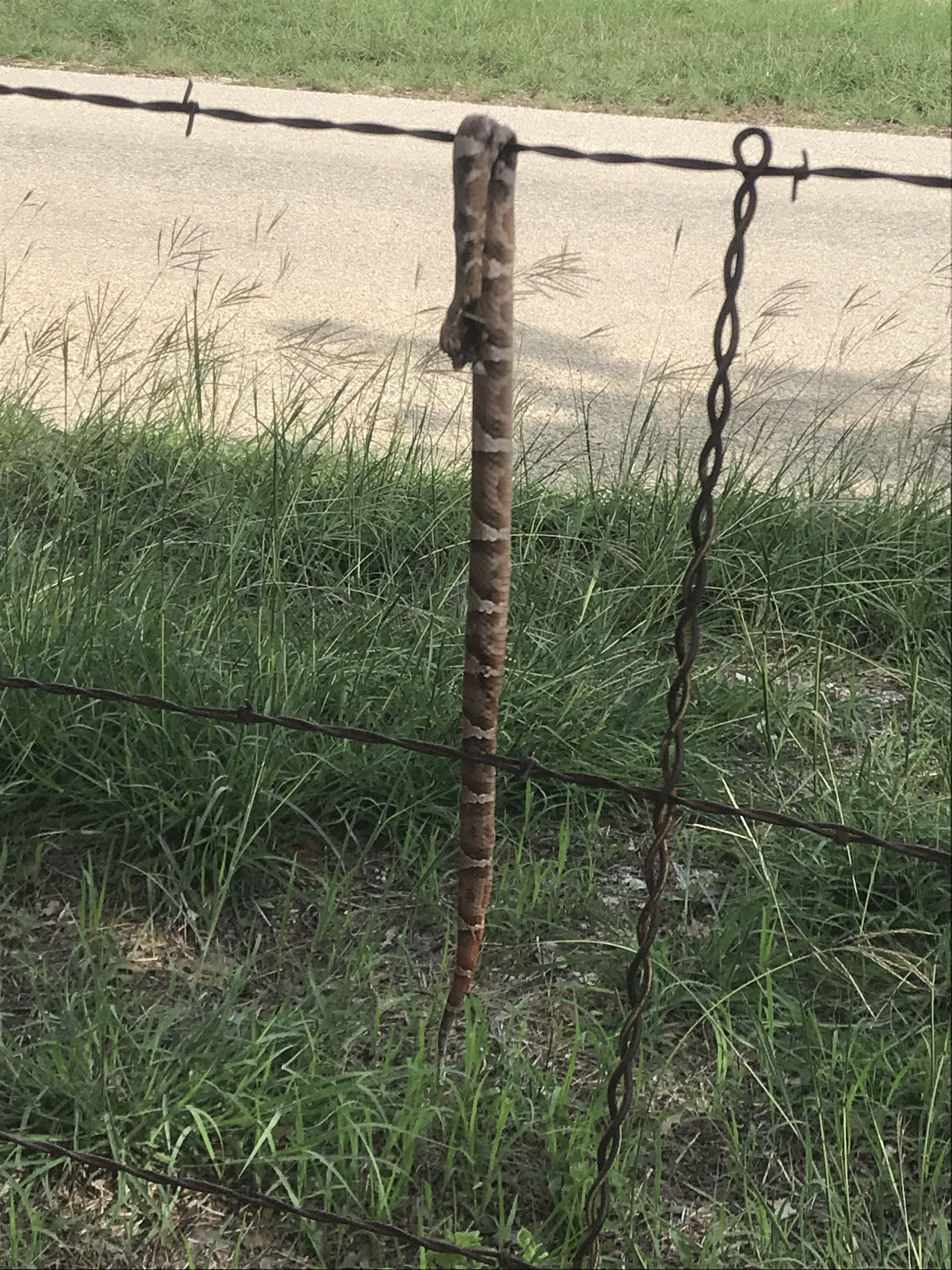
Several weeks passed. One Saturday I was out chopping briar vines by the road, and Butch was about 100 yards away, out of sight behind the house. I had just moved to a new tree and was pruning a few low branches when I looked down and saw a scaly cylinder patterned in shades of brown. I stepped (quickly!) back to the asphalt and shouted for Butch. No reply. I texted him–nothing. In desperation, I placed an actual voice call, but still no response. Was it a copperhead? I didn’t know, and didn’t want to leave the area and give it a chance to escape if it was. I took a picture, using the telephoto feature.

I sent the photo to two friends and asked, “Is this a copperhead?” Within a minute, one texted back in all caps, “VENOMOUS. DO NOT PET.”
I summoned all my lungpower from a lifetime of not smoking and yelled. This time, Butch heard me. About fifteen minutes and three gunshots later, the snake was no more. We hung the carcass on the barbed wire fence as a warning to others, not knowing that a snake hanging on a fence is supposed to bring rain.
And that, my friends, is how Wise County came to have one of the wettest Octobers on record.
 headmistress of headlines