Showy, Low, Good to Grow

Antelope Horn Milkweed can play a starring role in your butterfly garden.

Antelope Horn Milkweed (Asclepias asperula)

This US Southwest native herbaceous perennial is also known as Green-Flowered Milkweed and Spider Milkweed. It provides nectar for adult butterflies and serves as a host plant for youthful butterflies (including monarchs!) during the awkward, teenage caterpillar phase.

An Unusual, Elegant Accent in Arid Areas

The Antelope Horn Milkweed, named for its long, pointed seedpods that are reminiscent of antelope horns, has some of the most distinctive blossoms of any plant, anywhere. Imagine a golf ball on a tee, as interpreted by a florist. Or perhaps the two-inch spheres will make you think of a funky geodesic dome spacecraft from the planet Sputnik. Dallas denizens will definitely be reminded of Reunion Tower!

The purplish centers of these green and cream-colored blossom balls number as many as twelve per plant, and are beloved by checkerspots, monarchs, and swallowtail butterflies for their plentiful nectar. This milkweed is hardy in the warm, arid USDA zones 5-9, and requires as little as eight inches of moisture per year. It grows to a height of no taller than two feet, and a deep, robust taproot allows it to thrive in full sun and tolerate droughts that would decimate most other plants. Look for it growing wild along roadsides and in dry caliche, loam, sand, and clay soils.
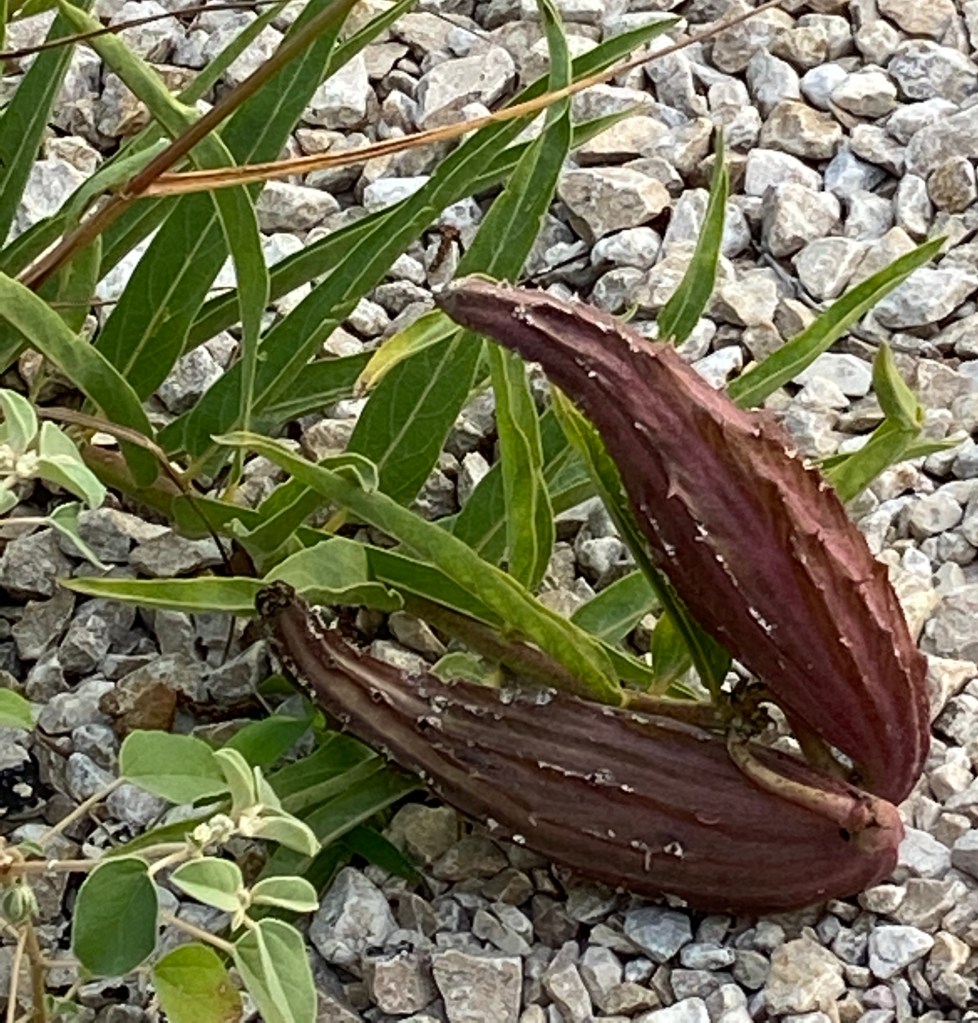
The seedpods that give the plant its name.

A Crucial Aid to Monarch Migration

Early spring is when the Antelope Horn Milkweed begins to bloom. Besides providing nectar for butterfly sipping, the plant serves as a host plant for monarchs, queens, and soldiers–which means the caterpillars of these butterfly species eat the plant’s leaves. As monarchs begin their northbound migration, the Antelope Horn is by most accounts the most popular milkweed chosen for the depositing of eggs. Gardeners who observe the plant in their plots have noted that they seem to always see at least one caterpillar on the Antelope Horn’s leaves!

The plant’s toxins are ingested by butterfly larvae (caterpillars), rendering them unpalatable to and thus protected from predators. These toxins also make the Antelope Horn a “must-avoid” for deer and other snackers.

The tenacious taproot of the Antelope Horn dictates that the most successful cultivation will happen when the young plant is placed in its garden home as soon as possible. Most containers will not be deep enough for this milkweed to thrive.

A Special Message for Texans

The monarchs who begin the spring migration journey northward are the long-lived, months-old “Methuselah” generation of the species’ lifecycle. These are, in many cases, the very same individual butterflies who passed through Texas on the way to their Mexican overwintering sanctuaries.

These particular monarchs are nearing the end of their lives, and their flagging strength dictates that they lay eggs on one of the first available milkweeds. Quite frequently, this will be an Antelope Horn Milkweed in Texas.

How can you help? To begin with, it’s best to not disturb any Antelope Horn Milkweed you may see growing wild. The long taproot makes transplanting unlikely to be successful. Secondly, add a few of these elegant milkweeds to your own garden beds. Texas’ location adjacent to Mexico puts Texans in a unique position of ability to aid our beloved monarch butterflies!
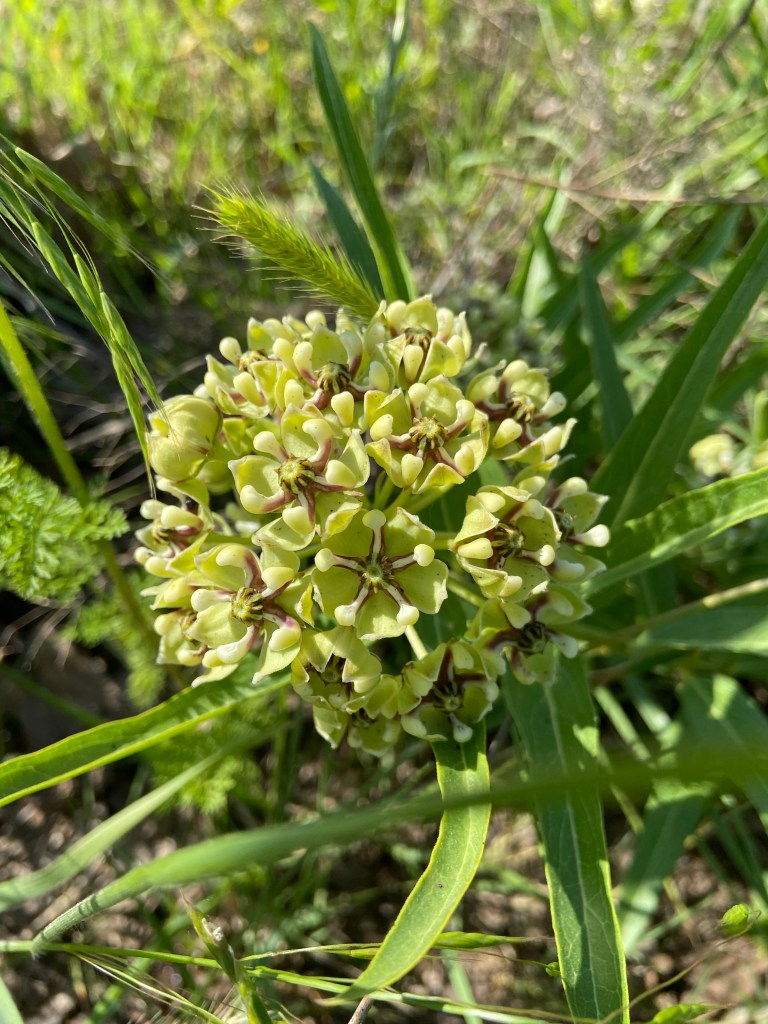
Antelope Horn Milkweed is a monarch’s MVP.

How it Happened

3:15 p.m. Butch and Adair are on their way out the door. Halfway to the truck, A says, “Wait. Should I go get the invitation?” B replies, “No, no. It’s not like it’s some kind of admission ticket. I know where we’re going, basically–just pull up the GPS when we get near downtown and we’ll be fine.”

4:15 p.m. A and B pull up to the Ashton Hotel in downtown Fort Worth. A comments, “I am pretty sure the invitation said there would be valet parking.” B is his normal lucky self and scores a free street space directly across from the hotel’s front door. He points out the truck unloading white folding chairs and observes that 4:15 seems pretty late for chairs to be arriving for a 4:30 wedding.

4:17 p.m. There’s not much activity in the lobby at all. The lady at the front desk is flustered and says she knows nothing about a wedding, but confides that her shift has just begun. She informs A and B that all ceremonies at the Ashton take place on the second floor and points out the correct elevators to use.

4:20 p.m. After riding up to the second floor with a rolling pallet of folding chairs, A and B set foot on a mostly deserted scene. A tiny crew is setting up for a ceremony in one room and the other meeting room is locked. No other guests are in evidence. A and B go back downstairs.

4:25 p.m. The flustered front desk lady looks in her book and volunteers that a wedding is, in fact, scheduled for today, but not until 5:30. A asks, “Amelia Daniels’ and Brent Austin’s wedding, right?” but in all her confusion, the lady never really answers. A is 99% sure she had the correct time, but since she has a history of getting scheduling wrong, wrong, wrong, it is assumed that this particular brand of idiocy has struck once again.

4:30 p.m. A and B walk half a block west to the Library Bar for a couple of drinks since they have about an hour to kill. It is remarked that everything seems a little surreal, a little off, and it’s also odd that they haven’t seen many wedding participants at all, much less anyone they recognize.

5:10 p.m. A and B go back to the second floor of the Ashton Hotel, which is still almost completely deserted. B chats up the only other person on the floor, a twenty-something girl sitting by herself in a chair against the wall. B discovers that she’s the wedding officiant. She volunteers, “Sam and I have been friends for almost all our lives.” A and B wonder if Brent’s nickname is Sam. B shares, “My wife walks the bride’s dog, and the groom works for one of my larger customers.” It’s the wedding officiant’s turn to look puzzled, but she just laughs and says, “Oh, really?”

5:15 p.m. Someone in charge (the hotel’s event planner?) materializes on the second floor and says it’s ok for A and B to go on in and have a seat. The room is completely empty except for a boy and girl with a guitar sitting at the front of the room. B asks, “Shouldn’t there be more people here already? The wedding is at 5:30, right?” The woman who may be the event planner says that everyone was gathering downstairs first, but at this point, we may as well go in and have a seat. For several uncomfortable minutes, it’s just A and B and the two people with the guitar who are sitting in front, facing the (nonexistent) crowd. B whispers to A, “This is a really small affair. Just 50 chairs are here!” A whispers back, “I know! It’s such an honor to be invited!”

5:25 p.m. The guitar duo starts to sing a song A and B have never heard before, ever. It’s still just the four of them in the room. The situation is awkward, to say the least, but thank goodness two tall girls with matching buzz cuts and wingtips come in and sit down. They are joined by a very short guy with a briefcase equipped with a shoulder strap. The woman who might be the wedding planner pokes her head in the room, and B motions for her to come over. “This is the Daniels-Austin wedding, right?” The possible planner says, “I don’t know the last names, but the brides’ names are Holly and Sam, short for Samantha.” A says, “Oh no! That’s not right! I don’t know how we got it wrong! I’m positive Amelia and Brent’s wedding was at the Ashton today!” Possible planner says, “I think I may have bad news. Did you know there’s an Ashton Hotel in Dallas?”

5:30 p.m. Since A and B have both ingested alcoholic beverages, they cannot jump in the truck and hightail it to the Ashton in Dallas. They resign themselves to leaving the truck in the primo parking space and walking to P.F. Chang’s for an early dinner. A knows it is all her fault for just assuming the wedding was at the Ashton Hotel in Fort Worth, and is sad, but manages to choke down every bite of dinner. B eats all of his dinner, too.

9:00 p.m. A and B walk in the front door of the house and make a beeline for the wedding invitation on the kitchen counter. It’s then they discover that there is a venue called the Ashton Depot in downtown Fort Worth, and that it’s different from the Ashton Hotel. It’s also determined that the Ashton Depot is actually only about a mile from the Ashton Hotel.

9:05 p.m. A says, “You know, the whole darned evening was absolutely surreal.” B agrees.

Fish Story

Our pond.

Imagine a pond. Clear and blue, or blue-ish. A calm, wide spot in a creek that carries fresh snow melt straight from the mountain’s peak over smooth, oval rocks, splashing a soothing background soundtrack. A pond surrounded by cattails and reeds that nod in a whispering breeze. This is not like our pond at all.

Our pond is murky at best, usually brackish. At its worst, at the tail-end of a fiery summer of drought, it is merely a muddy swamp festering at the bottom of a shallow depression. It is not fed by an upbeat little brook or a mysterious underground aquifer. It’s just a collection site for rainwater when the surrounding dirt has had all it can absorb.

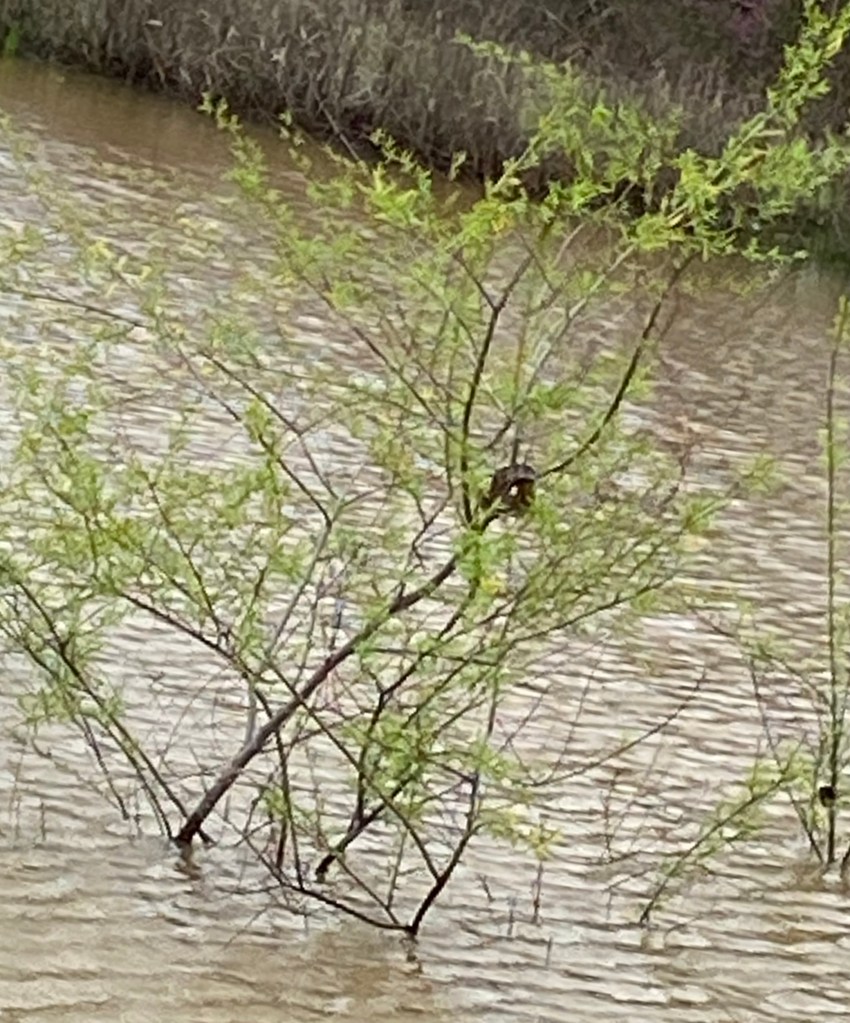
Some mature post oak trees near the shore help beautify the setting somewhat. Counteracting the gentrification efforts of the oaks are two spindly bush-like trees growing in the pond, near the middle. They are easily more than half-submerged when the pond is full. The horrid snakes who frequent the area swim out and twine their way up the branches to bake in the sun–until they are sighted and shot at. This prompts the snakes to drop back in the water, poking their heads out after a minute to enjoy a laugh at the shooter’s expense.

See the blob in the branches? That’s a snake.

Humans in their right minds are not tempted to dip even a toe into the pond, but many others besides the snakes enjoy swimming there–turtles, surface-skimming water bugs, tadpoles and their cooler older brothers, the frogs. Mosquito larvae also wriggle their childhoods away in the water, and this is why a friend suggested we add some goldfish from the bait shop to the pond. You know–to eat the larval skeeters.

Living in our little pond would be scummy, but it would have to be better than a career spent as a bait fish. And so, one April Saturday, we bought a dozen goldfish from the minnow tank at the OneStop, a local convenience store and dine-in restaurant. They were released into the pond, and the next day I saw only three of them. As days passed, I saw none at all, and figured that the turtles snapped them all up for snacks. I hated the fact that twelve fish had paid with their lives for my stupidity, and promised myself that we would never stock the pond again.

A pond resident looking suspiciously well-fed.

In early June, a visiting offspring swore he saw a flash of goldfish gold in the pond, and a week or two later, I spotted a few flashes myself. My best guess was that we had been able to retain between four and six fish after all–still a 50% casualty rate, but not the total massacre I had feared. By July, their survival was official; approximately twenty goldfish were swimming about. They were most often spotted in the middle of the pond, in two small schools. I hoped they were learning to eat mosquito larvae and to avoid the heron that had started to frequent the banks of their watery campus.

Summer wore on with sweltering days and no rain. The pond’s water level dropped quickly until it was within a couple of weeks of drying up entirely. I was unable to embrace a “live and let die” policy as far as the goldfish were concerned, and I spent odd moments hatching plans to capture whatever fish were left and then transfer them to a more reliably liquid environment. Thankfully, autumn rains fell before the pond dried out completely, but the fish had vanished. Sigh. I didn’t go up by the pond much because it was just a sad reminder of our failed fish experiment. We celebrated Thanksgiving and Christmas anyway, however.

Since our lives were just too carefree and uncomplicated, we adopted a dog in January. On one of our very first walks, I was surprised and delighted to see four orange circles in the pond–four separate little gatherings of goldfish! There were easily one hundred fish milling about. Talk about making a comeback! Of course, the heron came back, too, as well as the fishing feral cats, but still!

We imagined the fishy come-ons that were floated during the last few days of that summer drought:

“There’s a water shortage, time is getting late. I’m feeling kinda frisky– girlfriend, let’s don’t wait!”

“You and me, baby. There’s still water. Let’s make (fertilized) eggs!”

“We’ll probably all die anyway. Why not go out with a bang?”

Obviously, there’s a great lesson here about not giving up. About persisting despite overwhelming odds. About stocking up on eggs, because hey, you never know. For me, though, I think the takeaway is that I have no business having farm animals of any kind.

One of the elusive goldfish.

First Fire

“We don’t need more lighter fluid after all.”

We inherited a burn pile a year and a half ago.

It came fully mature; already ensconced on the property we purchased–no extra charge. It was every bit of four feet tall and eight feet around.

Made up almost entirely of broken oak branches and deceased leaves, it had been left to its own devices for quite a while. It was drier than a Bob Newhart monologue and already big enough to make it worth your while to set it on fire.

As the days passed, it continued to grow because we continued to feed it–endless ropes of thorny briar vines, whole mesquite trees, assorted weeds and more broken tree limbs. “Just throw it on the burn pile!” became the default answer to most disposal questions.

Weekend after weekend passed without burning this expanding heap. Sometimes there was a burn ban in effect. Sometimes it was raining. Days that were too windy also meant the brush pile would survive for another day.

At last, the spirit of Goldilocks descended, and the perfect Saturday to burn arrived. A permit was obtained and one of the offspring was enlisted to help. Three straw brooms were purchased and pails of water were set around the fire pit. There were also three fire extinguishers and a couple of shovels, just in case.

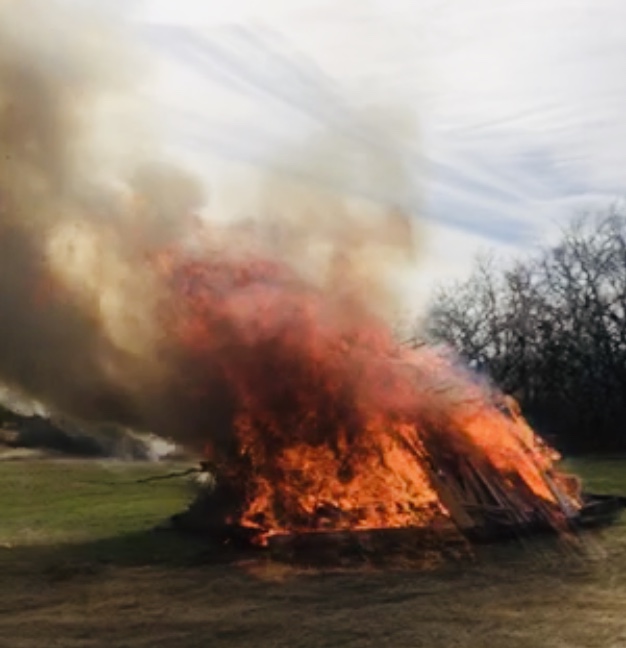
At this point, the burn pile was huge. It was easily 12 feet high and 20 feet in diameter. I believe it was no longer “burn pile” size. No, it was definitely in the “bonfire” category.

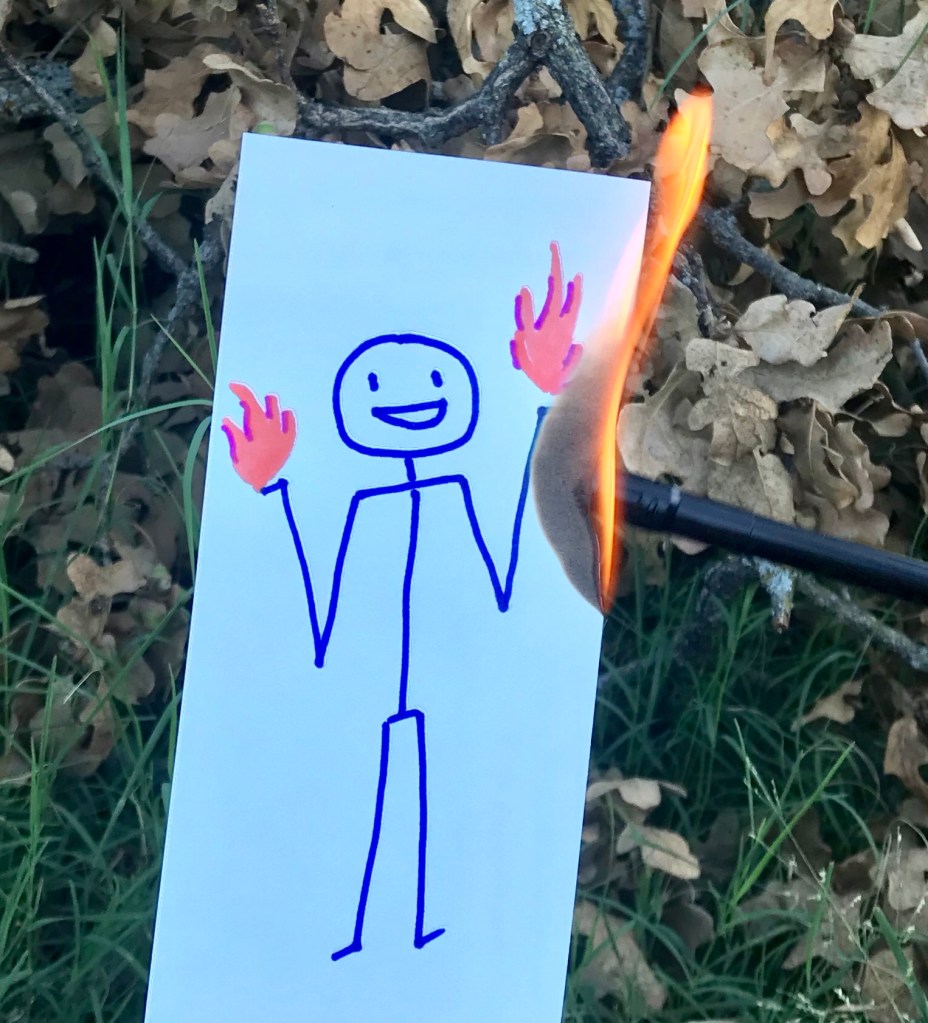
A celebratory sprinkling of lighter fluid was dispensed, and at long last, the fire was lit.

Not much happened at first.

I had enough time to say, “We may need more lighter fluid….” And then–whoosh! My hair was sucked upwards and all that dead, dry wood ignited. Flames engulfed the whole heap seemingly at once and the satisfaction of accomplishment combined with the thrill of danger. Serious smoke was visible for miles, and an understandably concerned neighbor called the volunteer fire department.

You guessed it.

My husband, the offspring, and I were standing around admiring the inferno and joking about how we were having our own little Burning Man event when we heard distant sirens.

“Do you think those are for us?”

The sirens got closer, and sure enough, several fire trucks turned in our driveway. At first, we were mortified that we’d taken them away from any real potential emergencies, but all the firefighters couldn’t have been more gracious.

The chief said that they’d gotten the call reporting our fire, and he’d stepped out the door of the mess hall to the sight of flames leaping high above the trees–our fire was that visible, even to the firehouse three miles away. He decided the crew had better respond, so they all headed out.

By the time they got to us, the initial towering fiery vortex had died way down, and Butch took everyone to show them the house construction in progress and pass out water.

One of the firefighters told the offspring that he should come by the firehall sometime and see about helping out at the VFD. The offspring was flattered and delighted.

All in all, it was a great day.

But we’ll never let the burn pile get this big again.

Unplanned.

image credit Matthias Zomer/Pexels

When she wasn’t looking.

Leslie was a freshly minted college grad, living away from her home state for the first time. She had scored an excellent job–social media manager of a start-up fragrance maker. The work itself was actually fun and her co-workers became friends from day one. Living the dream, young adult-style.

After three months, Leslie had settled in to her tiny one-bedroom apartment and was learning her way around the city. One Thursday morning, on the drive in to work (running late; what’s new?) she spotted a puppy alone on the side of the street. She could tell by the way he was dipping his paw below the edge of the curb that he absolutely could not be trusted to stay out of traffic, and just like that, she put on her hazard lights, pulled over, and scooped up the little guy.

He had no collar and no fear. Rode shotgun like he’d done it all his life. He was a beautiful grey and white marled shorthair, no bigger than a shoebox, and Leslie took him with her to work.

As you might expect, he was an instant celebrity at the office. A little cardboard box was fixed up, and there was a quick run to the store for puppy food, treats, and toys. “Found Dog” signs were printed, and Leslie put them up near where the puppy had been rescued, but no one called. Leslie named him Ron, took him to her apartment, and took down all the signs on her way home the next day.

Exciting–if slightly scary–news at Ron’s first vet visit. Ron was probably, at least partly, Great Dane. You remember Leslie’s apartment was small, right? For a few months, he stayed home and Leslie walked him at every lunch hour. When work got busy, she called the dog walker–and that’s when I entered the picture. Ron was a joy, and it was so much fun to see him learn how to navigate with his legs that seemed to lengthen as I watched.

After a few months of walking the ever-expanding Ron, he began to feel his size. He was not so easily led anymore–especially when he knew we were turning back to end the walk. A prong collar was tried, then a gentle leader. Leslie was beginning to despair. Was he too big for her to control? Where was her easy-going puppy of days gone by?

One evening, she had a double dose of insight. As she prepared to meet a date from Match.com, she realized Ron was acting out noticeably on the evenings when she left. The second light bulb moment was about five minutes into that night’s meet and greet. Leslie knew she needed a break from the online dating exhaustion–at least for a while.

And thus was born Leslie’s brilliant idea. She and Ron started walking on nice evenings to a dog-friendly craft brewpub with a small playground to accommodate the canine customers’ socializing.

Ron’s behavior problems slowly melted almost completely away with this extra activity. I was thrilled, and Leslie was ecstatic! Ron remained large, but not quite so aggressively in charge. He was noticeably more mellow on the days after a night at the brewpub.

The dogpark/brewpub was a lifestyle change for Leslie that she made for her Great Dane’s benefit, but guess what? In the course of Leslie and Ron’s frequent visits, they got to know one of the founders of the little craft brewery. He didn’t have a dog, actually, but he does now. It is Ron. He and Leslie and Ron moved in together–to a bigger apartment!

I think there are two morals to this story. First, sometimes life really is like a movie. And secondly, sometimes you find great things (and Great Danes!) when you’re not even looking.

A tale of two kitties.

(and one dog.)

Miss Kitty and Dillon were two long-haired felines who had just sashayed into town with their owner, Randall, and their canine roommate, Smoky. Randall had landed a new job and relocated cross-country. He inked the lease on his two-bedroom apartment before he realized that the location was a full hour’s commute to work. He was going to be away from home for twelve hours a day, five days a week. Smoky needed to walk for an hour midday, and that’s when I entered the picture.

Smoky was everything you look for in a male–young, handsome, and well-trained. He was such a sweetie that the long black and white fur he shed (everywhere) was easily overlooked. Our routine was this: I stopped by around noon and was welcomed to the establishment by Miss Kitty. There was a little time to pet her long, lovely mane until Smoky jumped off the bed and let me know the trees were calling.

We’d walk, and when we returned–treat time! For everyone! This was when Dillon would sidle in and accept a tiny triangular treat; but only sometimes, when his schedule permitted.

A few months into this gig, Dillon didn’t show for two weeks. When he finally did come around, I was unpleasantly surprised. His normally sleek and full fur coat was patchy and dull. There were areas where I could actually see his skin. I texted Randall the moment I left. “Dillon’s fur!! 😱 Is he ok??!!”

Long story short, the stress of the move and the pain of some urine crystals had probably caused Dillon to begin overgrooming. The crystals were treated, and he started taking mild tranquilizers.

After a few weeks, the excessive grooming was still evident–Randall and I would both see D. licking, licking, licking. What else could we do? We decided to try playing music in the apartment all day long. Why not?

For the next month, every day was different. Some days I entered a country music dance hall, and some days the vibe was smooth jazz. Fridays were usually a dance/house mix. Smoky and I cha-cha’ed more than you might think, and Miss Kitty seemed to chase the elusive laser dot more aggressively. For his part, Dillon bellied up to the treat bar with more regularity until he was available most days.

Thank goodness, Dillon’s overgrooming faded away and his fur grew back. Did the music help? Or did time just tick its healing power? We’ll never really know. The price was right, though!

Trendy.

image credit Helena Lopes /Pexels

These Trending Options Will Be Your Crowd’s Favorites!

ABC Event Planning is always your go-to for events that are current, parties that are popular, and gatherings that are ‘gramable–Instagramable, that is! Let us share the top four trends for corporate events in 2019.

Tech it up a notch.

Scavenger hunts are an ABC specialty, but the tweak this year is highlighted in the GPScavenger Party–a GPS-enhanced search around downtown Gotham. The ever-popular photo booth is upgrading with boomerang or GIF image files. We don’t need to tell you that finding new ways to share on social media is mega-appealing to many. You can even create a hashtag that boosts your brand awareness.

Well, well, well.

What have we here? It’s a revitalized focus on wellbeing. A healthy team is a happy team, after all. Stretch boundaries with a morning yoga class before the sales meeting. Relax attitudes with an on-site, end-of-quarter chair massage. And why not strengthen muscles and friendships with a fun run? Maybe with a craft beer at the finish line….

Great experience comes with the job (party).

If an activity is unusual, interest amps up! Think escape room, cooking classes, or even axe throwing! The more out of the ordinary, the more shareable on social media–we’re thinking axe throwing videos get the win here. Team cooking challenges are hot–especially bake-offs. Lots of photo ops, lots of sugar, lots of love for a Cupcake Wars-inspired team builder!

Slow down there.

The overscheduled and overtired among us are driving (wearily) the desire for a no-hassle, laidback get-together. Just a chill session at a fun place to eat and drink. A little downtime to hang out and visit. A company-hosted brunch where bottomless bellinis and bocce ball are the order of the day might be just the ticket. And remember–brunch means bacon. Bacon. Mmmmmmm.

Make it easy.

ABC Event Planning can help you design the events your corporate team will love. You don’t have to ditch the tried and true, but why not shake things up a bit and add a new angle to your 2019 fandangle? Contact John Smith (jsmith@ABC.com or 555.555.5555) to get more bang for your buck, and bacon for your brunch.

Venomous.

Slicker to Hick Blog

Do not pet.

Surprise!
(image credit Egor Kamelev)

I heard about copperhead snakes for the first time when I was about ten years old. The babysitter I loved, Mrs. Prickett, would sometimes entertain me with stories from her past. One day, she shared the saga of her run-in with a copperhead. She had gone down to her basement to retrieve a box, and when she moved it–surprise! There was the snake. It was surprised too, and opened its jaws and spat five little baby snakes at Mrs. Prickett, one at a time, one right after the other. Mrs. P rocketed upstairs and promptly threw a hysterical fit.

I dare you to forget this story. I certainly didn’t! When I told this cautionary tale to my husband, Butch, he said he’d always heard that snakes hatch from eggs. I pointed out that Mrs. Prickett had never lied to me. Google was called in, and we found out that a copperhead gives birth to live young, but babies grow in eggs that remain inside the mother’s body. So win-win-win; everyone was right.

We also learned that a female copperhead can store sperm in a kind of uterine safety deposit box. She summons those sperm to active duty when she decides the time is right; sometimes years down the road. She can also give virgin birth, producing what are basically little snake clones. Ms. Copperhead is a strong, independent snake who doesn’t need a male. She can choose to become a mom whenever she has reached a point in her career when pregnancy wouldn’t be too inconvenient.

Want a snake? Get a woodpile.

All this new knowledge was not much more than wow-worthy until we bought our little untamed patch of Wise County, Texas. We moved in June. Summertime, and the living was snake-y. It seemed like Facebook was filled with stories about close encounters of the viper kind–in a flowerpot, a fireplace, a woodpile. . . . One of Butch’s high school friends posted that one had slithered under her refrigerator and would not come out. She asked for the wisdom of the group, and the general consensus was that her house would have to be burned to the ground.

The first crew to work on the building we were finishing (the property included a half-built house) discovered an 18-inch rat snake living in the kitchen sink cabinet. They didn’t kill it because a rat snake is harmless to humans, if you discount the moment of heart stoppage when you first see it. They said they’d guide it outside if they saw it again, which is not as reassuring as it first may sound. I comforted myself by remembering that rat snakes keep the rodent population down. After all, I hate mice and rats, and I was the unreasonable parent who wouldn’t let the classroom rat come home with my son over the weekend. (You may have read about that incident in Mean Mom Monthly.)

Several weeks passed. One Saturday I was out chopping briar vines by the road, and Butch was about 100 yards away, out of sight behind the house. I had just moved to a new tree and was pruning a few low branches when I looked down and saw a scaly cylinder patterned in shades of brown. I stepped (quickly!) back to the asphalt and shouted for Butch. No reply. I texted him–nothing. In desperation, I placed an actual voice call, but still no response. Was it a copperhead? I didn’t know, and didn’t want to leave the area and give it a chance to escape if it was. I took a picture, using the telephoto feature.

Zoom feature.

I sent the photo to two friends and asked, “Is this a copperhead?” Within a minute, one texted back in all caps, “VENOMOUS. DO NOT PET.”

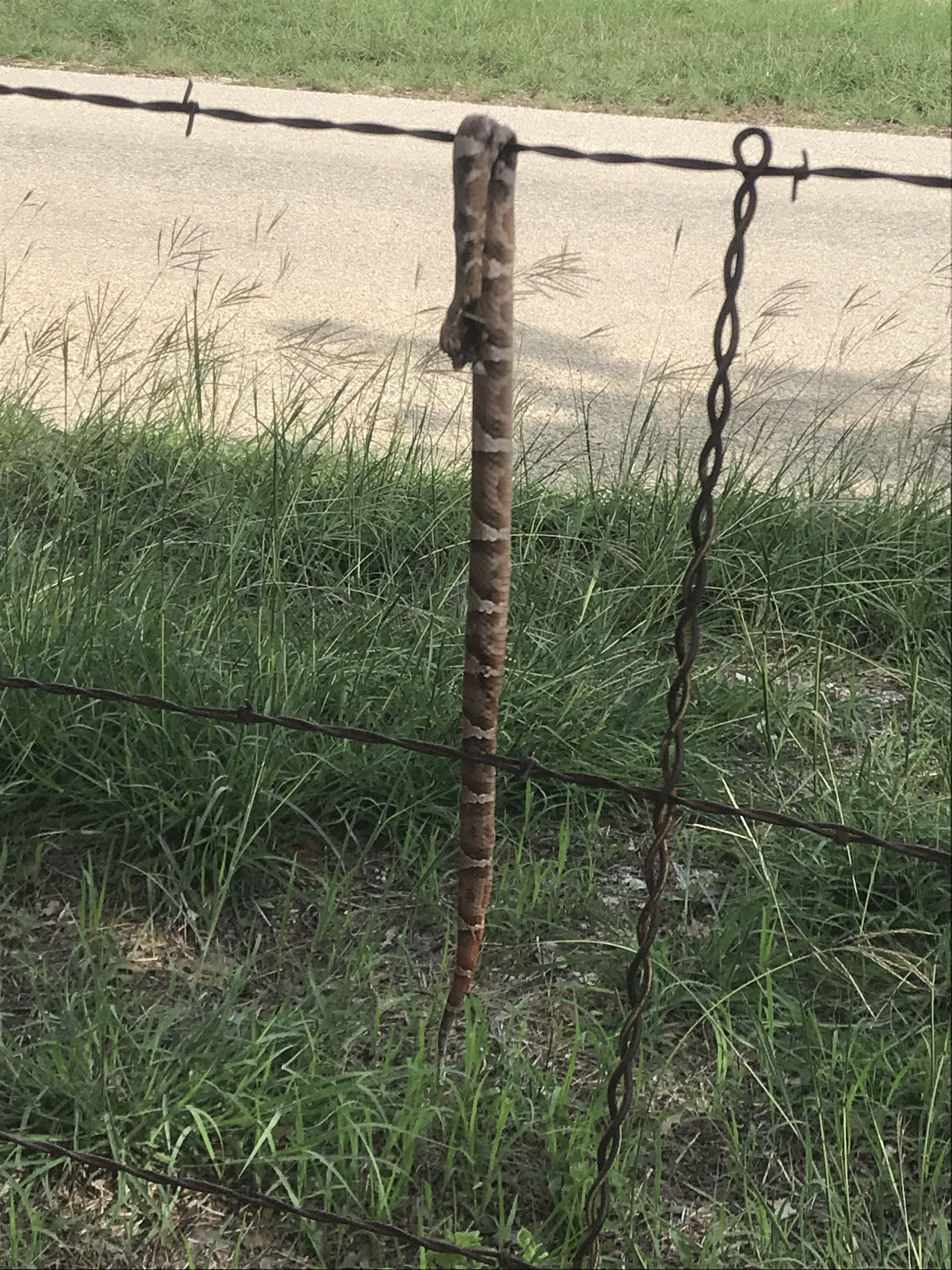
I summoned all my lungpower from a lifetime of not smoking and yelled. This time, Butch heard me. About fifteen minutes and three gunshots later, the snake was no more. We hung the carcass on the barbed wire fence as a warning to others, not knowing that a snake hanging on a fence is supposed to bring rain.

And that, my friends, is how Wise County came to have one of the wettest Octobers on record.

The end of the road.

Thorns, thorns, thorns.

Slicker to Hick Blog

When plants attack.

In my pre-rural days, the only literal thorns in my life were on rose stems. Those were easily avoided and forgotten in the excitement of “Flowers! He’s really interested after all!” But now. . .we live in a real-life Game of Thorns and I’m hoping we are wily enough to outsmart the little prickers.

The property we bought had been neglected for years, and one of the first things you noticed from the cocoon of your car was that each of the many trees was surrounded by a puffy skirt of vines and brush. I knew there would have to be significant clearing done around each tree, but I didn’t realize how much I would come to hate the vines.

In all its glory.

First look: what’s to hate? Leaves in a thin, heart-ish shape, attractively mottled in green with the occasional sassy red accent. And the name itself–Smilax. Smiling, happy Smilax.

“Gloves? We laugh at gloves!”

Closer look: see all those thorns? Placed all around the stem at about half-inch intervals or closer? Making it impossible to touch the vine, even casually, without a scratch or puncture wound? It became clear to me that the only one smiling would be the smilax vine itself, smiling in a smug little sneer as it drew yet another bead of blood. Or smirking, as it managed to snag a favorite shirt.

Thorny Smilax vine. I’ve also heard it called briar vine. If its scientific name isn’t Smilax satanicus, it should be. The property is overrun with these specimens. Even the smallest, youngest vines are densely studded with tiny spikes of peril, and each of the hundred or so trees has at least twenty malevolent shoots springing from the ground around it.

So how to eradicate these clinging ropes that will choke the tree to death if left unchecked? The vines’ leaves and stems are very waxy and impervious to herbicide–except in amounts huge enough to kill all nearby trees. Fortunately, they are easily clipped with lopping shears, but then they must be gathered and hauled off. Is that easy? Of course not!

You must grip the Smilax tightly enough to yank it from the thousand arboreal nooks and crannies where it has insinuated itself, but not so tightly that thorns pierce your glove. Many of our vines have had years to snake their way high into their host tree and are at least ten feet long. The vines seem to take particular delight in snapping back to scrape your face as you coil them for their trip to the burn pile. Another favorite trick is to surreptitiously clip you on the back of the ankle, sending a shot of adrenaline to your nerves as your panicked brain screams, “SNAKE! SNAKE! SNAKE!”

The rootball of all evil.

And now, we come to the root of this problem plant. Think of a subway. The roots of the Smilax form a subterranean network that channels nourishment to the stems that emerge at regular intervals and tunnel their way up to the sun. At less frequent intervals along the path, there is a swelling in the root like a big underground hub. It may be the brain of the whole enterprise. In any case, it is a horrid, bulbous blob with long, tapering spikes sticking out of it. It looks like Satan’s sweet potato.

But enough negativity! As it happens, the Smilax needs lots of sun to survive, and lopping it to the ground each time the vine emerges makes it weaker and weaker until it finally gives up the ghost. And all those vines harvested so far fueled a smoking hot bonfire in late December.

Going out in a blaze of glory.

Slicker to hick.

Slicker to Hick Blog

MVV Awards

One thousand bucks bought it from a fabulous, feisty woman up the road. She gave me her business card, which read “Ranch Goddess.” She was selling because her husband had died and she just couldn’t keep up with all the chores 50-plus acres demand; not by herself. And the latest boyfriend hadn’t worked out, so she had decided at last to hire out all the land maintenance. She wouldn’t be needing the tractor anymore. Besides, she was going on a cruise in three weeks and needed gambling green.

LBT with CBD and ACD.

The ’76 Satoh Beaver tractor came home with us, along with a high-sided plastic trailer that hitches onto the back. This gem of a machine would turn heads if it ever went into town–partly because the Ranch Goddess painted it a light, bright blue. The Satoh is small, as tractors go, but powerful enough to have pulled a carelessly parked sedan from the mud. It also extracted multiple wooden posts set in concrete blobs from the ground where they were buried. Its main job recently has been to drag its trailer partner to the burn pile to dump countless loads of thorny briar vine. The Satoh is always referred to as “LBT.” (That’s Little Blue Tractor, for the acronym-impaired.)

Sharing Most Valuable Vehicle honors is a 1996 Mazda B4000 pickup truck that we call The Mule. It has hauled, hauled, and hauled–mainly furniture and all kinds of construction trash. It has the endearing quality of possessing an air conditioner that blows a refreshingly arctic blast. The fact that it’s street legal is another big plus. The Mule spent much of its early life in the city of the Red Sox and has the rust to prove it.

Note the dent that adds even more character.

It allowed itself to be fixed with a $3 bolt from Lowe’s when the stick shift came off in my husband’s hand. This little pickup is the toughest of cookies and you never have to worry about scratching the paint or cracking the windshield–these things have already been accomplished.

Join me in raising a cup of diesel to toast LBT and Mule, MVV’s of the year here at Wise Acres!